What a week – my highlights from our first Primary care Digital Festival

Poster with squares, containing infographics associated with digital  and heading Digital primary care fest

I’m sure most of you will have seen the promotion, if not – here’s the Digital Primary Care Fest webpage again to see what you might have missed.   Most of the content is being shared on the new Digital and Transformation network, so please join over 200 new users in the last two weeks, and chat along with like minded people who have questions and ideas to help each other.

Anyone who has organised a week of events will know the required planning and how much effort this takes.  Not the wisest thing to do, but popping in 10 day holiday away and landing back in the UK a week before meant it was full steam ahead on my return. Although this added a certain amount of frisson, I’d recommend you avoid doing the same.  Our team of keen and dedicated people, put in the effort to make the week a success, and judging by some of the comments on socials, I think everyone found something of use.  And that’s what it’s all about, meeting people in similar roles, I think I saw the phrase ‘like-minded’ a lot, and the general energy throughout the days demonstrated that people had things to share and wanted to learn from each other.

I had the Custom GPT Hackathon to think about, but also attended the  GP Federation/GP collaborative event, and the Empowering Digital & Transformation Leads day in person, also joined the launch of the D&T Network, and the session on the White Paper, digital transformation in primary care; sharing insights from 2 years usage across 1700+ practices.  By the end of the week, I was both buzzing and very tired – I’ll blame that on delayed jet lag!

What did I learn?….

GP Provider Collaboratives (often built from Federations and Alliances of practices) in some areas still seem to be missing out of the ‘engagement’ loop in between ICBs and Practices/PCNs.  In addition to being Providers in their own right, for Enhanced Access and other ‘at scale’ services, many also employ the Additional Roles and the workforce element is resource heavy for them.  As ‘membership’ or representative organisations, they have a crucial role in engaging with their practices, which Commissioners could and should exploit.  This seems particularly important when trying to deliver consistency of services and access, across neighbourhood teams or using common digital products within networks, to offer equity of access beyond core hours. 

The ability to communicate at scale is also an opportunity.  Federations and Collaboratives can do this and ensure consistent information is delivered about primary care services at ‘Place’ or neighbourhoods, supporting practices and PCNs, using content shared across Websites and Social Media. Listening to the conversation about GP websites, I was transported back to 2017 and watching 9 practices independently create their own version of information about a new same day service, then posting it separately on 9 different websites. I’m not suggesting a separate website is needed for Enhanced Access, but I am still suggesting that content is created by the service provider, then pushed out once, across a common website platform, directed to and from GP websites, which is where patients will look to find out about appointment availability.  It’s still uncommon to see fully integrated evening and weekend appointment availability with the full primary care team, accessible to book online via a GP website.  Whilst there are great examples around where some Feds have got a hold of this, most are still on the first page.

Data – who’s uses it and why?

On both the GP Collaborative day and the DTL day, I shared our Digital Maturity Index, which we have just refreshed to include Online consultations and will incorporate telephony data in the new year.  There was acknowledgement in the room about the variation across practices, with nods of recognition of practices who may be further behind on their digital journey.  We always have an interesting discussion when I compare GP survey responses against Digital access. But looking at the Registration with a GP Surgery and spotting where Collaboratives can support working beyond just the practice, we could see opportunities to help with coding and summarising, also smoothing the Registration process across the practices.  Someone suggested that the ICB would find this data useful, and yes, perhaps through the lens of contract monitoring,  I’m sure they would.  At the same time, the Collaboratives and PCNs will be impacted by the success or failure of their member practices.  Relationships still seem to be a source of tension, as different primary care provider organisations work out their purpose and collective benefits.
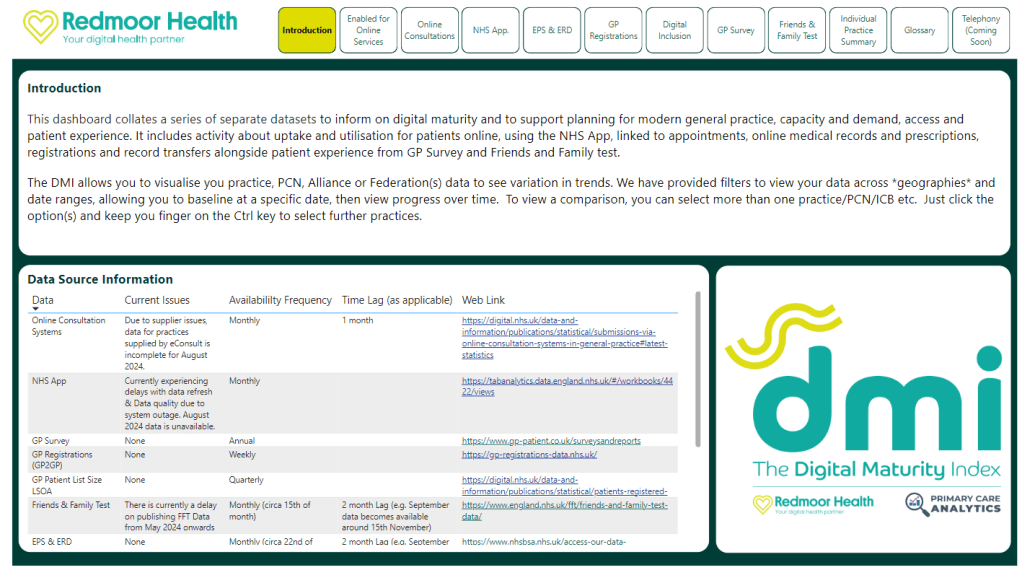
home page for Digital maturity index dashboard containing various data sets to assess progress for online services.  contains logo for DMI. datasources

The DTL (Digital & Transformation Lead) day.

We wanted this to be a day where DTLs shared their challenges, helped each other, offering suggestions about things that had worked well, and the DTLs were certainly active in this process.  I don’t know why, but I was surprised how many DTLs were ex or still acting Practice Managers.  I would have looked to move into that role myself if I’d not already joined Redmoor and we lost two great colleagues to the role when the jobs were first created. The DTL role is very much like practice management, hearing comments about feeling ‘quite isolated’, and needing to influence stakeholders at varying levels of seniority across organisations (ICBs, Clinical Directors, GP Partners, PCN managers, & practice teams).  Not so easy to do though, when not necessarily directly managing.  Others expressed a lack of clarity of expectation of the role both from commissioning and provider organisations, without much structure for development and very much relying on own resilience.  Some great ideas came through to maximise income for practices and PCNs, while still ‘ticking the ICB contract boxes’, and delivering time-saving initiatives in practice, that improve the patient experience.  I’m sure my colleague Dillon Sykes will have a blog coming out about his last two weeks, so I’ll leave him to share his thoughts too.
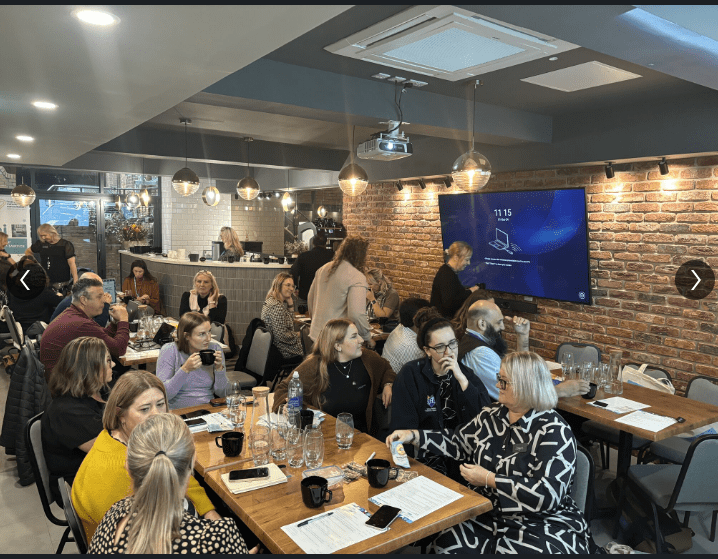
A group of Digital and Transformation Leads discussing their collective challenges, sharing ideas how to overcome.  Some sitting at tables, others facilitating the conversation

Now for the #Hackathon

The GPT Hackathon day was just the best for me, largely helped by the people in the room who needed little prompting to show their innovations. It was great to catch up with and see many familiar faces and to meet new people, whom I’ve only known online. As ever, the quality of the speakers and contributors kickstarted the thinking, with the morning devoted to learning all about AI and GPTs and the afternoon spent putting that learning into practice to come up with use cases.   A big thank you to Dr Keith Grimes, Curistica, and Chris Bush and Lee Valentine, Nexer Digital. We had a range of Tech enthusiasts, patient representatives, and inclusion specialists with us, alongside people who wanted to explore how GPTs could support them in daytime workload.  Some great ideas were sent in beforehand, in case the teams in the room ran dry of ideas, but a few wanted to use the opportunity to pitch ideas, before breaking out into groups to build.  I was amazed at how quickly everyone put the morning’s learning to good use and all teams delivered a solution in just 1.5 hrs.

List of problems that the team wanted to work on, includes Patient Management, AI admin assistant, Medical calculation, Smart Documentation, AI market place, Patient Communication Enhancer, Pathology management, Healthcare professional assistant

My colleagues Matt, Clare, Dillon, Stacey and Leoni were able assistants on the day and Matt recorded most of the sessions.  You can find Matt’s more detailed blog from the day containing the slides and videos if you want to have a more detailed look.

The learning for me is that we have a void of ‘governance’ that is leading to caution in many and on the flip side, people possibly working outside the ‘safety zone’, not understanding the risks or personal liabilities.  One of the hacks was to create an AI marketplace, where people could visit to find out more, where suppliers could offer support and clinical safety, alongside governance guidance.  They built a quick GPT for suppliers to check if their product needed DCB0129 & DCB0160.  I can see a need for a follow-up round table event with representatives from ICO, CQC, Regulators, Medical Defence unions, Medical, Nursing & Management representative organisations, alongside NHS as Commissioners and Standards organisations.  Then we can explore where the concerns may be, what the actual risks and liabilities are vs those as perceived and who these currently sit with, and who they might be covered by in the future.  Until we move this away from independent practitioners to the wider NHS system, we cant harness the opportunities that AI can bring or manage the safety at scale.  I posted on the NHS AI forum afterward and the suggestion of building an ‘AI Charter’ together might help us all.

Always great to feel like you’ve delivered something that makes a difference, so sharing a few posts from others who enjoyed the day, Dr Amar Ahmed, Dr Sheikh Mateen Ellahi, Dr Andrew Noble, Dr Stuart Berry, Dr Chris Nortcliff and Chris Bush.
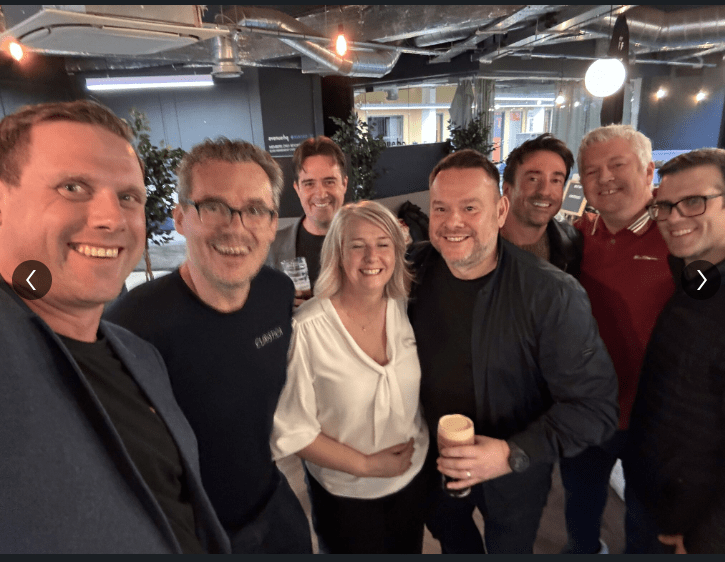
The attendees at the Hackathon, posing for a photo at the bar, smiling for the selfie, one holding a pint of guiness

Finished with a pint to celebrate – sorry for spoiling the photo with my eyes closed but like to be consistent 🙂

Drop me a line if you want to put your name down for the next session.
AI in healthcare – are we ready for this?

As we approach the end of the first quarter of a new Government, I’m taking a moment to reflect on a few papers and articles released and considering these against my experience of trying to use and implement Digital in the NHS. 

I’m sure many of you will have seen or commented on the recent paper ‘Preparing the NHS for the AI Era: A Digital Health Record for Every Citizen’, as part of the Future of Britain policy initiatives.   As usual, it was met with the full range of commentary, from enthusiasm and welcome support to the obligatory dumbing down headline about ‘chatbots doctors’. Dr Charlotte Refsum, Director of Health Policy, Tony Blair Institute for Global Change summarises the key points in her LinkedIn post (which is where most of my blog readers get their information these days since the demise of X – but that’s another story!) 

Please can we fix the basic requirements first?

I totally understand the response: ‘Please can we fix the basic requirements first’.  One of the biggest surprises when I joined the NHS 20+ years ago, was that the basic user requirements for tech were at least 5-10 years behind the nuclear industry that I had worked in previously.  I recall being astounded at having to submit a business case for a £250 desktop multi-function printer/scanner to save hours standing at a photocopier, printing patient records, then re-typing that information into templates to be sent by email, and then yes, posting the paper records to the PCT HQ. My request didn’t get approved – I moved on.

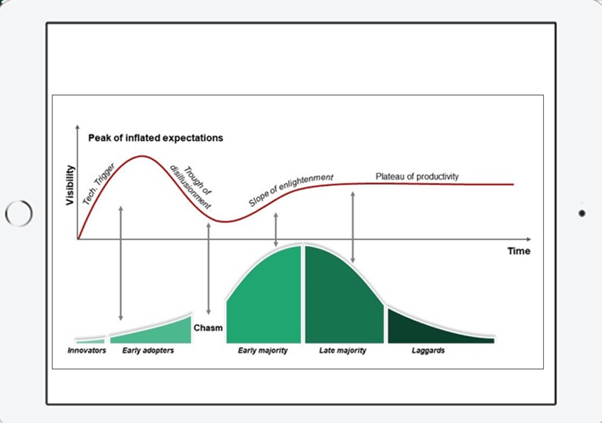
During those 20 years, we have seen variable improvements, some big-scale projects start, get delayed and then scrapped, and a lot of money paid for products not used. I use this image regularly in my presentations and it feels like the gap between the early adopters and laggards seems to be widening, as well as the hype increasing, quickly followed by the trough of disillusionment. I still take part in video meetings with practice teams, all huddled around one PC.  No spider phone, or owl camera in the meeting rooms, and some don’t even have a webcam and headset to participate fully.

image of Gartner hype cycle and Everett rogers innovation adoption curve

The Citizens Digital Health Record (DHR) and Primary/Secondary Care interface

I’ve been an advocate of patients having access to their full medical records for 10+ years since I worked in practice and could see the value to patients as well as to our workload. However, creating a new multi-sector DHR in light of the legitimate concerns around procurement and data security is not without challenges.  Seeing the attempts to share and view patient data across health systems has been soul-destroying in some instances.  The requirements of PCARP – ‘cutting bureaucracy’ and addressing the challenges of the primary/secondary care interface seem to be thorny too, with the bureaucratic referral process incorporated in the BMA collective action guidance.  As a Commissioner in Cumbria in 2008 looking at part of this work, I recall a discussion with an Orthopaedic consultant defining the pre-surgery baseline test information they required. I asked why Primary Care couldn’t just create and supply a ‘view’ from the relevant part of the GP clinical system to Secondary Care. It has been technically possible for some time, but still not done. I still see each ICB or Region reinventing this wheel or worse, not addressing this issue at all.

The Technology Innovation Framework ‘new market entrant’ clinical system suppliers are still building functionality to send and receive ‘documents’ into and out of hospitals because they have to design the new systems to ‘fit’ with existing NHS systems and workflow.  Secretaries spend hours listening to digital audio recordings and populating templates, administrators uploading or archiving the same, all to ensure the correct coded data is sent from A to B, or to make sure payments can be attributed for the work. This is light years behind where it needs to be in thinking and design.  Why are they not designing these new systems to allow secure structured data flow and visibility, separated from ‘task handovers’, with a ‘patient friendly’ version alongside?  I’m sure many of us have looked at our records in the NHS App and wondered what on earth some bits of it mean. So now, I’d say that people need access to their ‘health information’, not their ‘medical records’ – its subtly different. Clinicians need medical information in order to advise or treat, Managers need a different set again. Transferring care, is different from the information that patients need, as is the need to track flow of activity for demand, capacity and resourcing, and then capturing outcome data to check that the intervention works. It surely cant all sit in one DHR, can it?

Lord Darzi’s review

There will be many that comment on yesterday’s release of the Independent investigation of the National Health Service in England, AKA the Darzi review, for many it contains no surprises.  This review along with numerous papers and articles all feature Tech or ‘Digital, not Analogue’, and AI as a central part of the solution. Those of us involved with change, implementation, and optimisation know, that the Tech alone will not suffice.  Having the headspace to think differently, when you’re up against the clock, or burning out so you can’t even consider taking the risk of doing something new, all needs to be factored in alongside the Tech. Let alone addressing the working across silos.

Exhilarating and terrifying – not just the internet, but AI

Then I came across this old clip of David Bowie predicting the impact of the internet in 1999 and I have to say, I can have similar feelings about AI – it’s both ‘exhilarating and terrifying’ at the same time. I can get enthusiastic when I have a call like the one I’ve just had about predictive analytics, taking millions of data points and using AI to understand the trends. At the other end of this, I do more than roll my eyes when I see glib predictions that AI will solve all our problems, or replace the need for people, or be the only source of the truth.

Having worked with patient and staff data, and understanding the requirements of data controllership, the risk of data breaches seems a priority, closely aligned with clinical safety and acknowledging bias in all its forms. All the marketing hype is about efficiency, so it is great to see sensible guidance being released.

Dr Dave Triska offers his expertise with A Gold Standard Checklist for Healthcare Professionals Using AI & LLMs quickly turned into a super easy video by Dr Hussain Gandhi at eGPLearning. Both helping to highlight key tasks and risks for GP Partners & Practices, as they explore using these new technologies, whilst asking if the products popping up on the market are safe and secure.  
Thinking Critically about AI in Healthcare from Dr Jess Morley is well worth a look at too.

As the system strives to move more and more services to digital platforms, leaving people behind, who may already be digitally excluded and suffer poorer health outcomes as a consequence, is equally important.  Nexer Digital offers practical service design advice in this blog post by Chris Bush; AI for all; Inclusive design principles for the use on AI in the Public Sector and Danny Lancaster offers us real-world use cases to help us consider how AI tools can support a more inclusive workplace, not just a more efficient one.

So, with all of this in mind, we’ve decided to get the experts in the room and see how we can solve some of the core General Practice problems, using AI safely, inclusively, and effectively.  When we asked people to tell us what problems they like addressed, it’s the mundane, repetitive, time-consuming things, not the boundary-pushing stuff.

A close-up of a word cloud containing Administrative, queries, tasks, managerial work, admin, triage, letter

If you’d like to join us at our Custom GPT Hackathon on 3rd Oct in Leeds, to learn, share knowledge, and maybe enjoy a pizza even whilst having fun, why not come along and find out which side of the David Bowie ‘AI line in the sand’ you’re on?

A screenshot of a chatGPT o1 being asked 'okay, show me what you can do

Meanwhile, I’m leaving you with an image of Dr Keith Grimes, staying up all night testing the new ChatGPT models in preparation.

I’ve been to London to see the…..

Getting the best out of remote and digital general practice

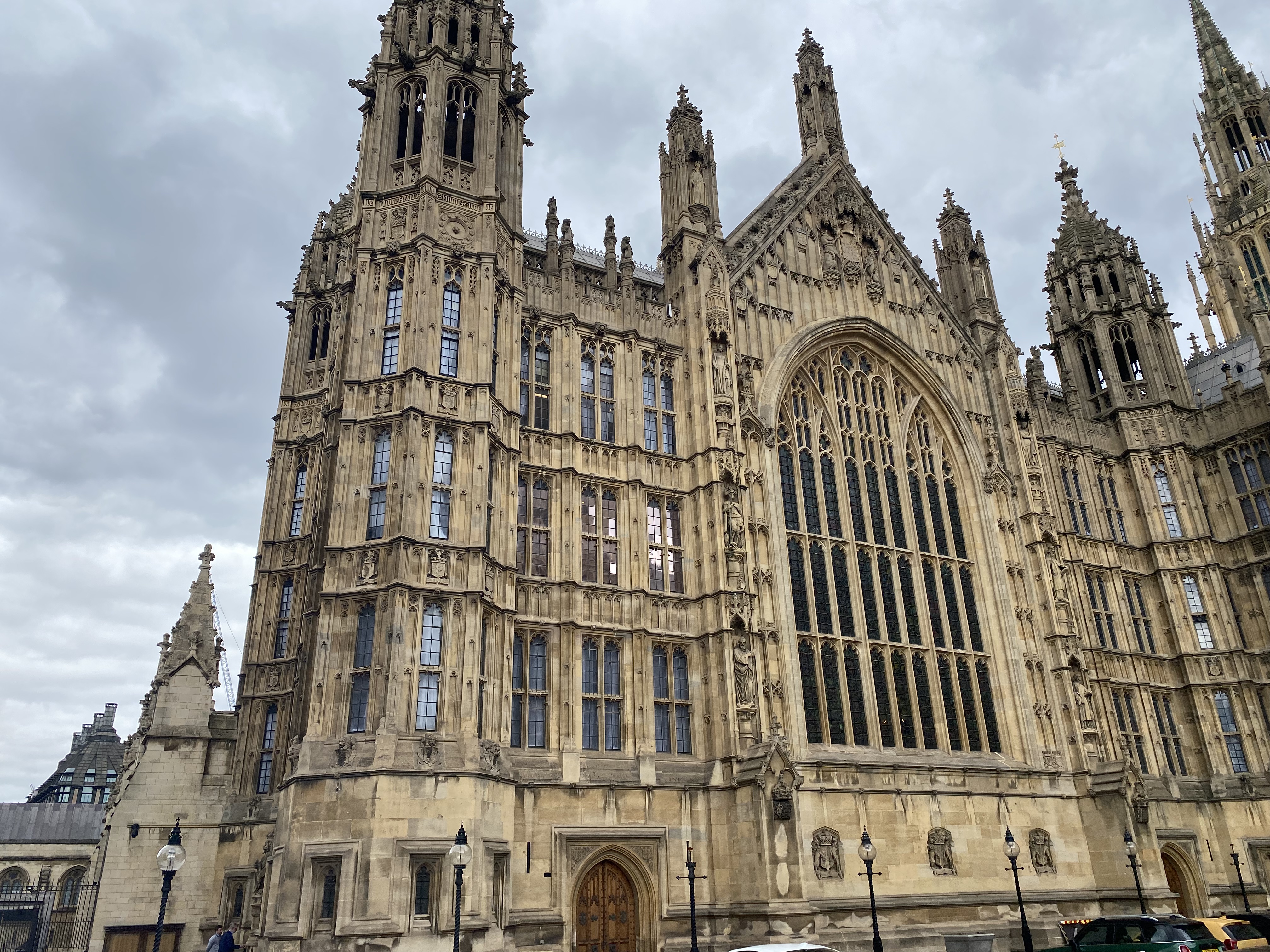
Image of Houses of Parliament

Some of you will know I live in beautiful scenic Cumbria. So, you’ll have an understanding all about lack of public transport and how flipping hard it is to get anywhere in a hurry.

Some of you will also know that I have a touch of FOMO, so when I get an invite to two things at the same time, I struggle to decide and often think, maybe I can do both.

The dilemma

Our Redmoor team were having a redesign session on 24th April, partly in response to some NHS contract changes, partly because we’re 12month into one programme and 3years into another and we wanted to reflect.  Also, because we want to look forward and make sure that our products and services support a hugely stressed system in General Practice, and we have the expertise in the team to help.  

Then, I get this invite to an event presenting the findings of quality research by the teams at Oxford, Plymouth and the Nuffield Trust, delivered in the House of Commons, for MPs to listen in order to understand the issues and complexity of modern general practice remote care.  The research team have created this summary to share, so that others can learn from the 2-year study and build the findings into their work. 

I’ve been involved on the edges, as part of the expert advisory group and as a participant in a series of workshops, but this is very much part of my everyday work and something I’ve been passionate about in the NHS for many years.  How could I turn that invite down.

I decided to attempt to do both sessions.  One from the train, the other in person. 

Plan for the unexpected

What I didn’t plan for was a horse event, total disruption to the road network, and it being ‘surgery day’ at the House of Commons, resulting in the longest queue to get in, the fastest transit through the building and security, and arriving just slightly late for the session (along with three others, reassuringly – I wasn’t the only person who mis-planned).  For those expecting selfies with the Ministers – no time for that I’m afraid.

The event in person

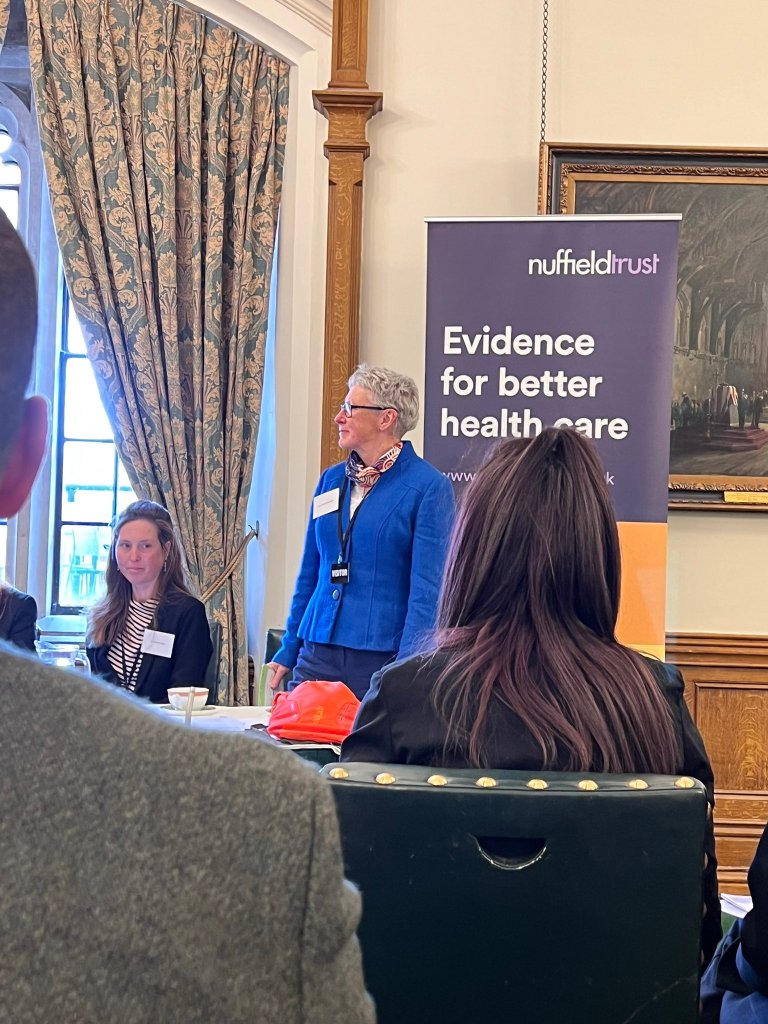
Professor Trish Greenhalgh describing some of the personas affected by remote consulting

During the presentation, hearing the personal stories of those affected by ‘Remote by Default’, as receivers and providers of services, will always bring you down to earth, irrespective of the magnitude of the setting.

Professor Trish Greenhalgh and Dr Emma Ladds sharing some of the experiences from the research

The strongest message I heard is that people need and value continuity of care to get the most from the experience, prioritised over quick ‘transactional’ access.  Secondly, that delivering and receiving care remotely (telephone, online, video, asynchronously) can be safe (see Table, p10)  but that training and developing the right culture is as fragmented as the technology used to deliver care. Thirdly, that the purchasing of technology is not just about the product, but the variability of its implementation has resulted in unequal impact (see my other blogposts). Finally, that although the NHS has plans to embed this into education, it will take a long time, and General Practice need the help now.  

So, the training needs and competency framework are super helpful, and for those supporting general practice this research is gold dust, as it should inform the basis of any training and advice. 

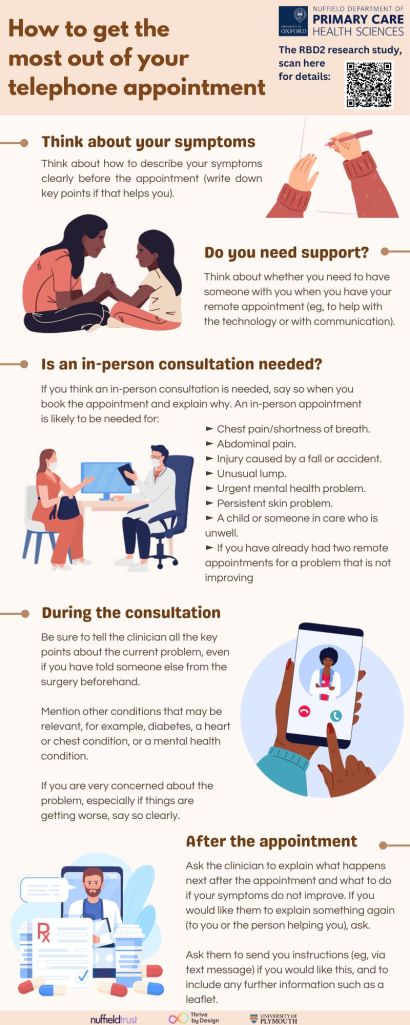
We’ve already used this patient facing communication created by the researchers and posted out a social media campaign across 700+ practices to over 30k patients to inform and encourage people to access care this way. 

How to get the most from

image containing information about symptoms, if you need support, when an in-person consultation is needed, what to do during and after the consultation

Although it was a flying visit, I met and hugged some incredible people that I’ve only ever seen on screen or interacted over socials. I sat beside someone who also hailed from the North and it transpired that I knew their father – how Cumbrian is that!

What happens next

The research team are sharing their learning on a public zoom event on 22nd May, so watch out for details if you’d like to join us.

The event from the train

Back at the Redmoor office, the team had a successful day too and now have a clear plan for our digital and transformation products and services, so watch out over the coming weeks/months for updates. 

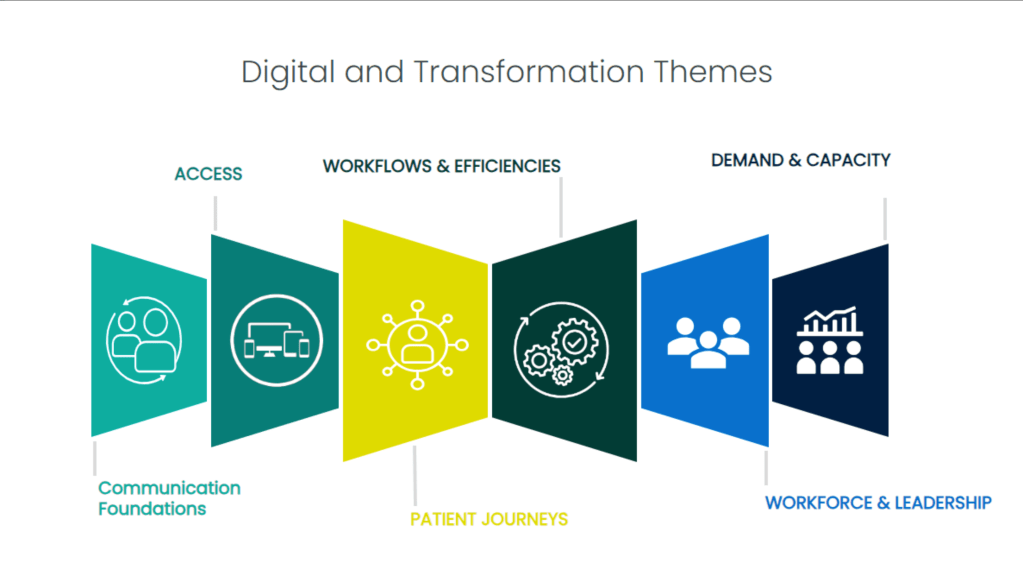
Digital and transformation themes, noting Communication foundations, Access, Patient Journeys, Workflows and Efficiencies, Workforce and Leadership, Demand and Capacity
Digital and transformation themes
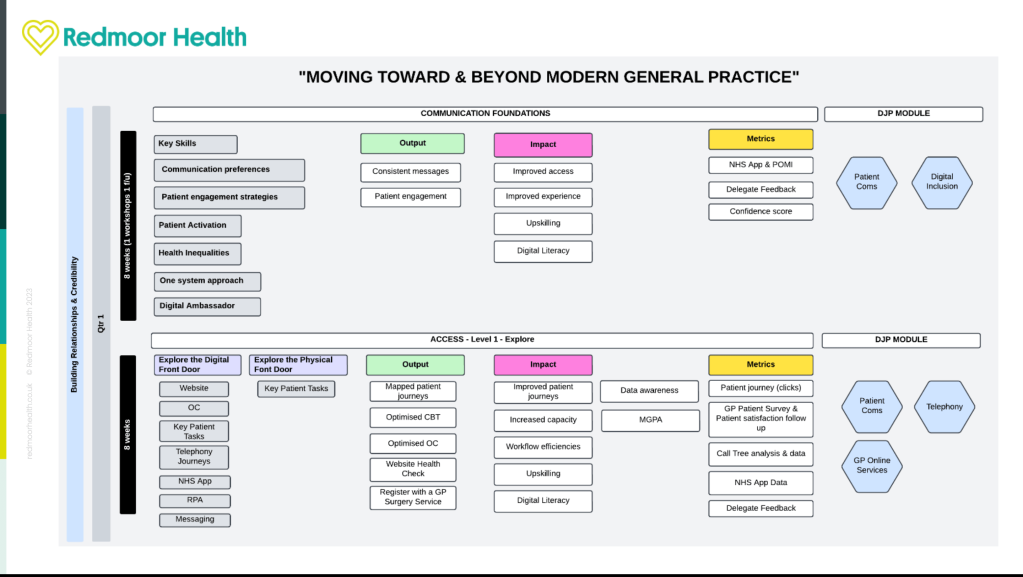
Moving toward and beyond modern general practice - an image describing all the key skills, outputs, impact, metrics involved
Moving toward and beyond modern general practice

Finances, procurement, reorganisations, research, and new models of care

We took part in our joint HSJ Awards - Best Consultancy Partnerships interview with one of our clients this week, as we come towards the end of a 3-year programme. As one of the original gang at Redmoor Health, it was nice for me to reflect on the successes of a strong relationship, developed to deliver a long, multi project programme aimed at increasing digital access, improving patient communications, upskilling the workforce and supporting the Digital First team to deliver their aims.   I took a moment to consider this strategic partnership against the current climate of change and chaos in Primary care and thought I’d share some musings with you. BTW, its 8mins long so get yourself a brew and ponder with me.

Finances

Its that’s time of year, when in the last quarter, there is traditionally a frenzy of activity in General Practice. Teams are chasing patients and are working hard to recoup any finances earned throughout the year to maximize payments, following delivery through QOF and the Primary Care Network contract.  With only 7 weeks to go to the new financial year, uncertainty over pay and contract negotiations is making next year’s planning harder than usual.

Throughout 2023, there was a raft of new guidance, contract and service changes that managers needed to understand.  ICBs and Regions are now comparing progress against targets and seeking assurance or evidence of improvements against new criteria before they can release payments. Some are excelling at this, others finding it hard work. That’s on top of the usual round of heck, we have to spend this money before year end last minute decisions. Previously, we’d agree with our clients to receive and hold this year’s £s, then together work up a more detailed scope for delivery into the new financial year, when their priorities are a bit clearer and they can engage properly when primary care have more time.  With the reorganisation and requirement for a 30% reduction in costs across NHS Regions and ICBs, some people are facing redundancy or moves to other jobs, consequentially, loss of local organisational knowledge and decision-making inertia is becoming clear.  Also, the combining of primary care transformation and digital budgets is affecting financial flows and prioritisation of projects.  Clawbacks on unspent budgets are being mentioned in dark corridors and on socials, which is a sad reflection both on the plans and especially when primary care need the funding right now. 

Primary care contracts

One element of the PCN contract is the capacity access and improvement payment.  Unsurprisingly (clue is in the name) this is largely about improving patients experience and access, with payments linked to improved appointment recording.   As part of our Digital Managed Service, our team have been supporting PCNs to deliver this guidance, contract changes and ‘new models of care’, so my super colleague Dillon Sykes and I thought this might be a topic for discussion at our session at Best Practice, London on 28 & 29th February.   We’ll explore some of the headlines, overlaps and gaps, ponder a little around the various checklists and criteria to be met, then hopefully share some practical steps to help.

We are seeing lots of angst that the General Practice Appointment Data (GPAD) dashboard still seems to contain inaccuracies and a lack of clarity over what is counted, and how to make historic changes etc that will impact on payments.  New to the ‘additional roles’ stables are the Digital &Transformation Leads and alongside PCN Managers, both are still trying to understand appointment mapping guidance released in 2021.  Clinical system providers have released workarounds in the last couple of months as temporary fixes. Frustrations are appearing between General Practice and PCNs as the data is held and configured at practice level, but the impact is felt in the PCN.

It’s great to hear that some ICBs are supporting well, providing datasets throughout the year to keep an eye on progress.  We are sincerely hoping that ICBs take a pragmatic approach to releasing the final 30% payment, whilst the data is still ‘more than a bit flaky’ (technical term).

To help with GPAD, our team ran webinars and held 1-1 sessions with practices or new D&T Leads to go through their configuration and data. We produced a simple GPAD tool to help navigate the guidance and we’ve also asked passed on quite a few questions to people in NHSD/E to gain clarity.

Procurement of new digital solutions

This last year’s quarter is also a little bit different though, for many suppliers of services and products to the NHS. It’s not unusual for slippage in the NHS, but some of the key elements of the Delivery plan for recovering access to primary care that slipped or were reprioritised, will have knock-on consequences for many colleagues in the product and supplier landscape.  This will also affect practice teams and inevitably, on patient services.

Many commissioners were getting ready to re-procure their digital tools to support Modern General Practice Model, but the Digital Pathways Framework on the Digital Care Solutions buying catalogue due in Aug 23, then moved to Dec 23, still isn’t released for commissioners to purchase from. 

I’m fortunate to occasionally take part in user research and know the NHS team are working hard to make the experience of the buying catalogue better, but this delay has impacted on ICBs, PCNs, Practices, Product suppliers and support organisations like Redmoor.  Part of my job is to seek out new partnerships and products that will help to improve General Practice, and I love chatting with new suppliers to find out how their solution will help.  There are a few with products that will knock your socks off but are not available to purchase from the existing procurement frameworks. Some PCNs are bravely buying directly, as they can already see the value, but many are nervous or don’t have the finances to buy direct, especially if their local ICB is expected to and will fund (or even part fund), once the new buying catalogue is available.

As a consequence of the delay, it looks like many commissioners have little choice but to extend existing digital solution contracts for another year. This can leave practices with products that they didn’t choose or don’t use and patients don’t like to use, so stick with the conventional methods of access (Telephone).  So, in ‘kicking the can down the road’, existing suppliers breathe a sigh of relief and new products don’t get into the market, leaving us all feeling just a little bit frustrated at what might have been for another year.  Do we invest time and energy trying to optimise solutions that we know don’t fit the needs of our staff and patients?

Our new procurement support service logo

Suppliers tell me they have lots of interest from ICBs and PCNs but can’t recruit to scale up delivery until they know the contracts have landed.  There will be a rush at the end, and we know deployment and implementation will suffer. These tools are essential to deliver high quality 21st century primary care. Having been through this process with one of our strategic clients last year, we have experience and are well positioned to support suppliers and ICBs with market and practice engagement, early implementation, adoption and spread. So, if you want to plan early, drop us a line and we’ll walk you through how we can help.

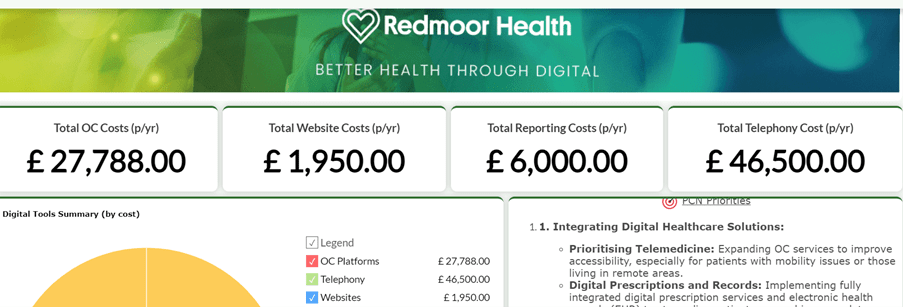
An example PCN dashboard showing the costs and variation of products in use.

Research

In addition to user research for products, I also contribute to research for new services in development and I’m delighted that NHS are developing a guide to improving messaging. This has become such a complex area, since the inclusion of messaging as a requirement for all online consulting tools. The NHS is paying twice for quite a few functionalities and the holy grail for practices was always to have digital solutions in just one platform. There are a couple of suppliers doing this extremely well, and with the increasing desire to reduce SMS costs, data messaging is the way forward for many. One super research project that I’ve had a small involvement as part of their Expert Advisory Group is the Remote by Default project from the teams at University of Oxford and Nuffield Department of Primary Care Health Sciences. They’ve released some great resources following a 2 year study into remote care. We’ll be helping to push these out to patients in over 700 practices via our Social Media managed service, and will build the training competencies into our programmes, so we are confident that our work is grounded in rich research. What is interesting, is the different approaches across the Nations. Scotland have procured one video consulting platform for the whole nation to use, with a contract to 2026. This means they have one set of patient facing resources and one training platform for all practices and users. Very different to our market place approach in England and probably a lot less confusing.

Now – lets’ talk telephones

As another example of what I’ve just described in the procurement section, lets have a look at the requirement for Advanced Cloud Based Telephony.  Seen by some as the panacea to ‘the 8am rush’ and made a requirement in the GP Contract by end of 2025.  The Better Purchasing Framework was issued, some ICBs took advice and started to plan the ‘at scale approach’, working out whole system requirements, engaging with practices and PCNs to gain advantages of greater purchasing power, optimise local infrastructure and achieve some consistency of service offer – great stuff!   Then a letter appeared late Nov, expecting all practices to sign up by 15th Dec 2023 or they would miss out on the funding opportunity.  Thankfully, someone realised the well-earned Christmas and New Year holiday was looming and the deadline to select a supplier was moved to 15 January 2024, with a signed contract by 2 February 2024 and go-live by 25 March 2024, with all features in place by April 2024 at the latest.  Just another added pressure in the last quarter of the year.

Now there is anxiety over where the costs will land, and we had a flurry of requests to help people make a choice urgently, so they didn’t lose out on funding.  We had others that had already moved to cloud telephony before the contract requirement was released, but had chosen suppliers not on the framework, so maybe didn’t have all the features mandated in the new contract.  Some practices had been earlier adopters, made the investment then found that there was support to buy out of existing analogue contracts.  Or course, anyone that has ever implemented new technology knows you can’t do it in a rush without good planning. Then after deployment comes the real fun – how to make it work for you.  We saw this happen during the pandemic with the necessary but rushed roll out of online consultations.

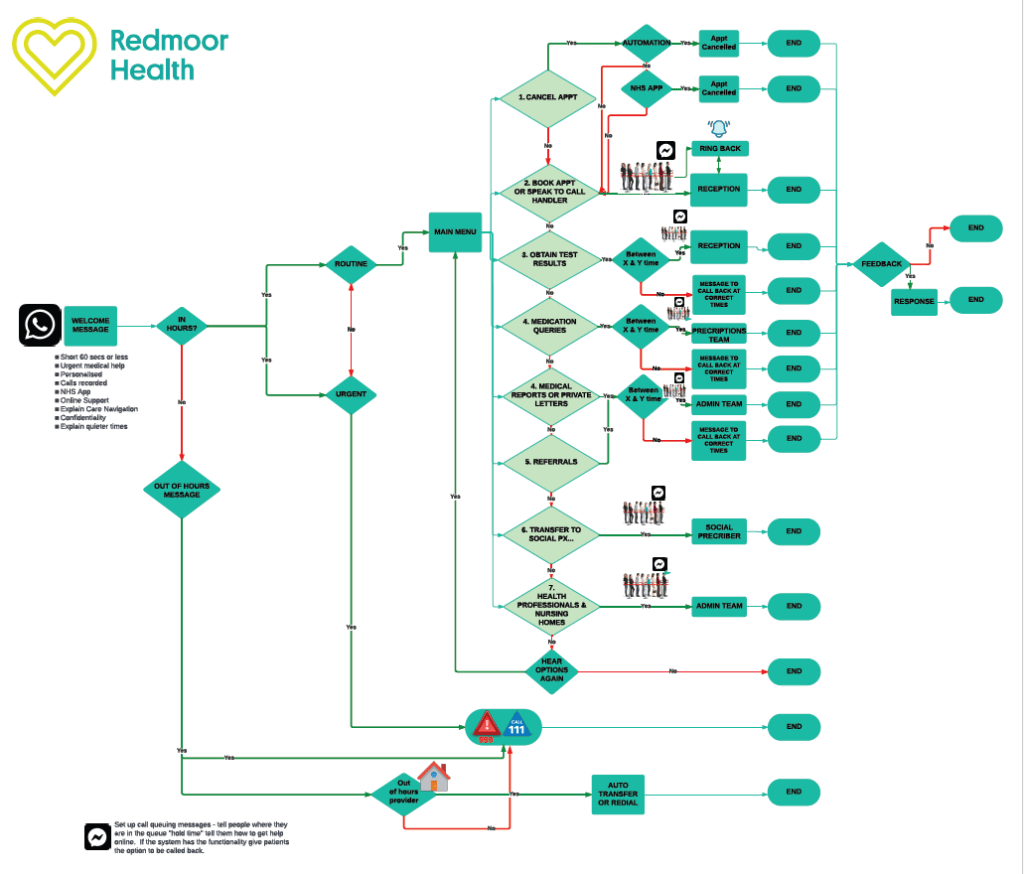
Our team have been delivering workshops, listening to and improving auto attendant messages, optimising call flows, aligning with online service options, all to ensure fair access to services and an improved experience for patients. And then of course we threw in a Digital Journey Planner module around planning and optimising Telephony.

This is just a flavour of our support on offer to help the NHS at all levels in primary care to navigate the noise, help with the priorities, support the providers to deliver, optimising the solutions available.  We hope you can come and see us at Best Practice at the end of the month, we’ll be at Stand D45 talking all things primary care improvement.

Book here: https://ow.ly/Tf6050Qz6sE

If you cant make it, drop me a line or get in touch hello@redmoorhealth.co.uk because we love to help and know a bit about your world right now.